Thursday, January 20, 2011

You never know

Something I like about Florida, particularly the southern section and the Everglades, is you never know what wildlife you might see. Above is a young cottonmouth snake crossing a road where I was riding my moped. Poisonous, cottonmouths are not something you want to mess with in any way at all. They are alleged to be aggressive, but this one took one look at me, camera in hand, and then raced across the road into tall grass.
Cottonmouths grow to an average of four feet in length. Again riding my moped I came across the one above on the side of the main road in Everglades National Park. He was struck by a car only minutes before I came along.


Even after they're dead, snakes can reflexively bite. The man above and I were both very careful to stay clear of the snake's head. He had a large mouth that opened to over an inch wide.

You just never know what you're going to see. I was washing dinner dishes shortly after dark in a campground's wash sink. This squirrel tree frog above was sitting to my left just above eye level on a ledge. He/she and a few of her friends kept me company every night I did the dishes. I came to look forward to visiting them every evening.


How would you like to look up in a tree directly overhead and find this customer? I believe he's a harmless corn snake. Two friends and I had been chatting directly under him for a good 20 minutes.
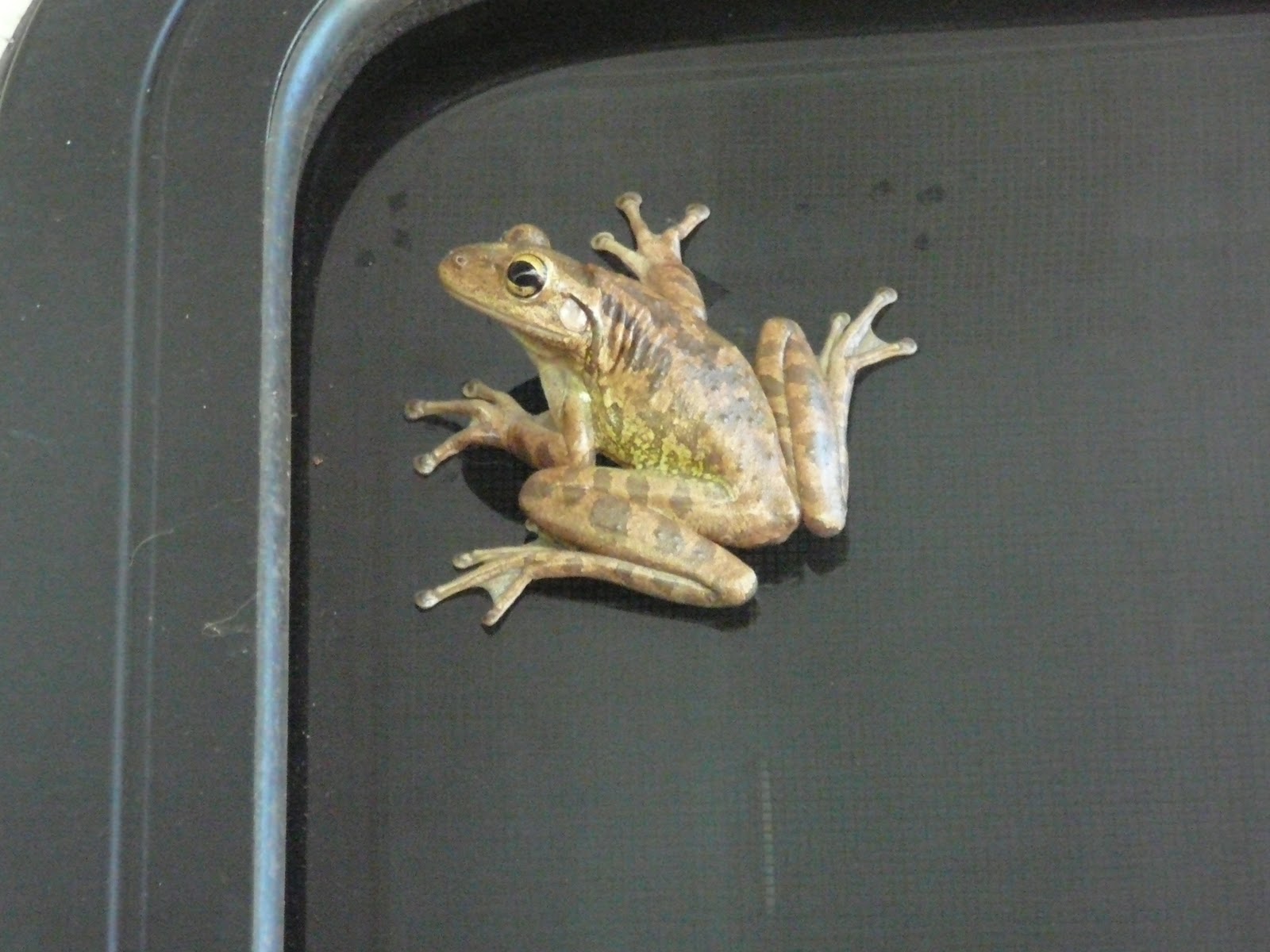

This tree frog looked the inside of the RV over before moving on. When we moved the window curtain aside, I don't know which of us was more surprised.

No Florida photo blog would be complete without an alligator.

The scariest moment I had with an alligator was while exploring on my moped. I was in the Fakahatchee Strand Preserve in southern Florida on a road called Janes Scenic Drive. An unusual play of light over a small pool of water and waterbugs caught my eye. I parked the moped, got the camera, got down on one knee near the edge of the pool and shot several pics. The pool was only about 20 feet in diameter, little more than a big puddle. I did not notice an alligator was lying on the bank opposite from me because I was so intent on trying to capture the unique shadows and water close to me. Suddenly he launched himself directly toward me and went under about ten feet away. I froze. And waited. And...nothing. He apparently was content to be under the surface and to leave me alone. I backed away slowly, mounted the moped, went home and then returned. Only this time I carried a Buck knife on my belt. The only weapon I had when I encountered the gator was my camera. A lot of help that would have been! Of course by then the light had changed, and there was no trace of the alligator.

Wednesday, January 19, 2011

Common and beautiful

Something that happens a lot in Florida is you come across common but beautiful birds and animals. The Great blue heron, for example, is found in all 48 lower states in the U.S., but one never fails but to impress with its size (about four feet tall), beauty and stateliness.
This fellow above I came across in an area called The Anhinga Trail near the Royal Palm visitor center in Everglades National Park. All sorts of wildlife can be found there including alligators, turtles, snakes, fish. In the above photo I managed to capture both the Great blue heron and his relative the Little blue heron.
Above is the Great white egret. He's close in size to the Great blue heron. They both hunt seemingly oblivious to nearby alligators.


Once while hiking in the Big Cypress Swamp, part of the Everglades, I startled a young little blue heron. It panicked, tried to fly from the ground and alight in nearby trees. It was inexperienced in both taking flight like that and landing and fell from the tree into the water underneath. There was a big splash and Presto! the bird had vanished into the belly of a waiting alligator. 

Making a statement

In the eastern section of Everglades National Park, there's  bridge on the main road spanning an extensive wet area. Fishing isn't permitted from the bridge, and this red-shouldered hawk emphasized the point.

Tuesday, January 18, 2011

Paradise Lost

One campground host would have campfires every night. He also turned on a large electric light. The light and fire attracted large insects which, in turn, attracted a mated pair of barred owls. Above is one waiting by the campfire to catch one of the insects. When they captured one, they would take it back to their nest to feed their young. When I tried taking their pictures using a flash, the bright light greatly disturbed them. One flew over my head, raking my hair with his talons. I got the message and switched to available light and my night vision video camera. The photos weren't as great, imbued with a green tinge, but I was fortunate to get this close. One lighted on an empty chair next to where I was sitting. I could have touched him.


A year after our first encounter with the barred owls around the campfire, we returned to that campground. We arrived later in the winter, and two chicks, pictured above, had left the nest. Their parents were still feeding them and teaching them how to hunt. They lived in towering live oak trees covered in Spanish moss. They blended in with the  gray moss making  it difficult to spot them and to get good pictures. Like their parents they were not afraid of people, more curious about us than anything else.


The following year we arrived at the campground later than the previous year, and the two new young chicks were larger, more selfconfident and funny. The one above sat on our television antenna for several minutes examining it closely. Another one perched on a windowshield wiper and peered in at us. He left, however, when I approached with my camera. The two chicks hung out together, hunting insects, toads, mostly on the ground often within ten feet of us.

The following year has no accompanying photo. The owls had left for a simple reason: someone had shot and killed one of the mated pair. We could hear the survivor's distinctive call, but it was always well away from the campground.

More of my favorites -- butterflies

Florida is loaded with beautiful butterflies, beautiful flowers and combinations of them. The ones  above are a couple of the most common. On the thistle is a Gulf Fritillary and below are  Common Buckeyes. The two buckeyes together appeared  to be courting.


Small yellow butterflies are common and are usually members of the Sulphur butterfly family.

Monday, January 17, 2011

Favorites from past trips

Over the course of five to six winters spent primarily in the Everglades, I've taken hundreds of photos. Many photos have stories to go with them. Here is a sampling:

This photo is of an osprey eating a fish while perched on a roadside sign. If you examine this photo closely, you will see very fine lines running through it.This is because I was taking it through a window screen of my RV. The osprey was within a few feet of the window, ignoring me altogether. Without the screen between us I could have touched him.

Another:


A deer is just a deer, right? Wrong. This one was being stalked by a Florida panther. I had been taking pictures of the deer and filled my card in my camera. I was deleting photos when I heard a growl to my right. My dog, Buddy, was holding tight to my right side. The deer was to our immediate left. As the deer crossed our path and moved to our left, it unknowingly placed us between it and the panther. And, boy! was that cat ever mad! He growled three times, a very distinctive low, deep growl. I saw only the deep grass move where the growl  came from. It moved away from us and disappeared. I get goosebumps every time I tell someone of this encounter.

And more:
This young red-shouldered hawk allowed me to get up to only about ten feet from him. He never moved away from me while I snapped about 20 pictures. He must have only recently left the nest and still hadn't learned fear of people. I left and came back an hour or so later, and he was gone. I never saw him again.

And again:

I was directly underneath this osprey in our 14-foot skiff!! He'd look at me as I took pictures and actually seemed to enjoy it. I swear he was posing at times. He never moved away even though we were only about 15 feet below him. 


My latest trip to the Everglades

I've presently spending the sixth winter straight in Florida. Over the course of these trips I've accumulated hundreds of wildlife photogrphs. A friend encouraged me to start a blog, so here it is. I'm hoping people find it interesting enough to read and return to it from time to time. Here is one of my favorites. If you click on it, the photo enlarges, and the bird becomes clearer.


This is an America bittern, a bird that blends in with its surroundings so well I felt myself lucky to even spot it. I was at the entrance visitor center of Everglades National Park, on the east coast, Homestead side of the park. The walkway into the center bridges over a wet area, and Voila! there the bitttern was. I thought at first it was a piece of cardboard.

Here are two more of my favorites:

This is a baby alligator sunning itself at my feet. He/she was only about one foot long.

This is the above baby's mother. She has one of seven babies (that I saw) on her back. The others were close to the shore of Mzarek Pond in Everglades National Park and very close, within a few feet, of me. Mother alligators stay with their brood for 1 to 2 years, protecting them as best they can from predators such as male alligators. She staued about 150 feet from me, usually a safe distance, but she made me nervous anyway.

And, 

I felt lucky to catch this picture of a Snowy egret out of the water with its "golden slippers" on display. He landed within ten feet of me at Mazrek Pond. Usually you see snowies wading through water hunting for food and their feet are out of sight. They are a beautiful bird hunted almost to extinction for their feathers around the early 1900s. The feathers decorated "stylish" ladies' hats.

That's all for now. I will post photos frequently.